Restore spinal stability and move with less pain by addressing spondylolisthesis. At Restorative Spine Center of NY, our board-certified orthopedic surgeons treat vertebral slippage that causes lower back pain, leg weakness, numbness, sciatica, and posture changes, using minimally invasive, motion-preserving solutions that help you return to daily life faster.
RESTORE SPINAL STABILITY.
Minimally Invasive Motion-Preserving Solutions

CONDITIONS TREATED
Common Symptoms:
Spondylolisthesis occurs when one vertebra slips forward out of alignment over the vertebra beneath it. This most commonly develops in the lower back and may result from degeneration, repetitive stress, injury, or structural defects in the spine. As the vertebra shifts, nearby discs, joints, and spinal nerves can become compressed or irritated. You may experience lower back pain, stiffness, numbness, leg weakness, or sciatica-like symptoms. In advanced cases, spinal instability can affect posture, walking mechanics, and mobility.
- Persistent lower back pain that worsens with standing or movement
- Tight hamstrings and reduced flexibility through the lower body
- Numbness, tingling, or burning sensations in the buttocks or legs
- Sciatica-like pain radiating down one or both legs
- Muscle weakness affecting balance, walking, or daily movement
- Stiffness contributing to posture changes or a forward-leaning stance
- Tenderness directly over the affected vertebrae
- Difficulty transitioning from sitting to standing comfortably
- Changes in gait, including instability or a waddling walk in advanced cases
- Bladder or bowel dysfunction caused by nerve compression in severe cases
Possible Causes
Spondylolisthesis develops when the structures responsible for stabilizing your spine can no longer maintain proper vertebral alignment. The vertebrae, discs, facet joints, ligaments, and surrounding muscles work together to distribute pressure and control movement. When one or more of these structures weakens or becomes damaged, a vertebra may gradually slip forward over the one beneath it. This shift can narrow the spinal canal, compress nearby nerves, strain surrounding muscles, and increase instability throughout the spine.
Several underlying conditions and injuries may contribute to this vertebral slippage, including:
- Degenerative disc and joint changes associated with aging
- Stress fractures caused by repetitive spinal hyperextension
- Sports-related overuse injuries affecting the lower back
- Congenital defects involving the vertebrae or spinal joints
- Direct trauma from falls, car accidents, or impact injuries
- Arthritis-related cartilage breakdown within the spine
- Bone abnormalities or tumors weakening the vertebrae
- Repetitive strain from physically demanding occupations or activities
- Previous spinal injuries that altered spinal alignment or mechanics
KEY BENEFITS & WHAT TO EXPECT
Preserve Motion. Return to What You Love.
Diagnosis
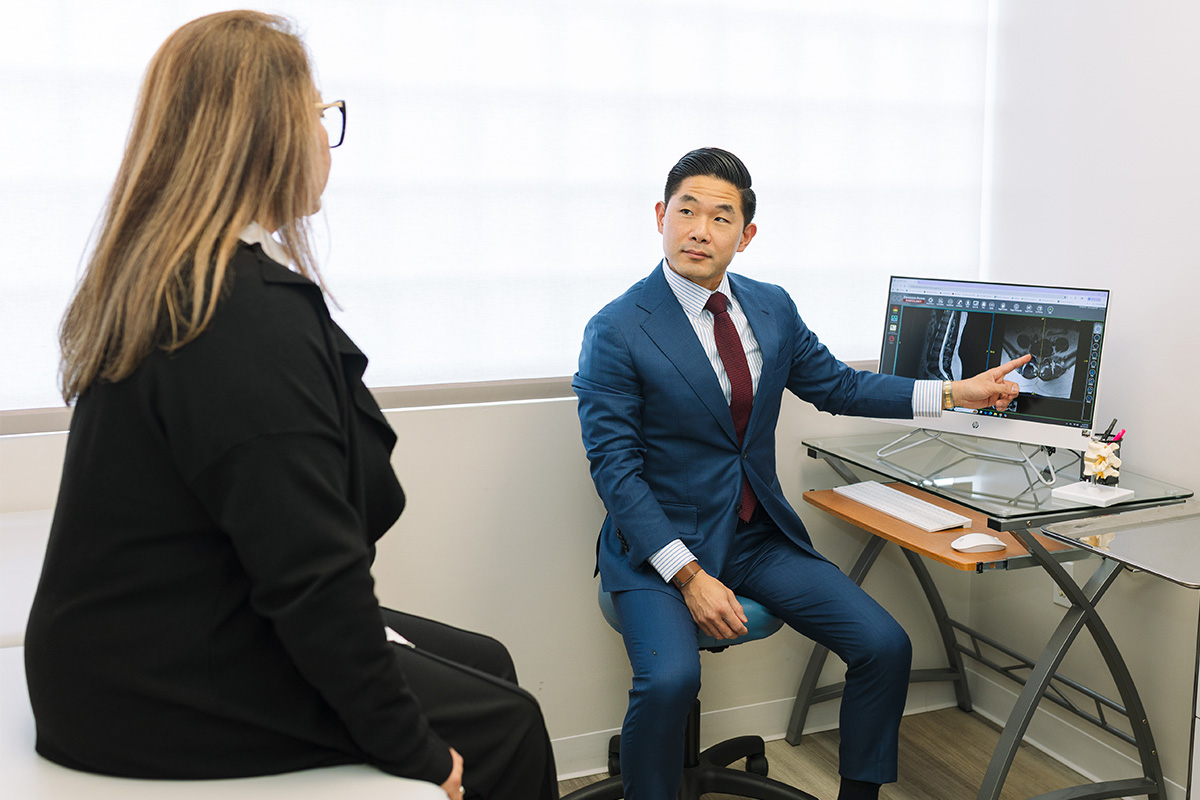
At Restorative Spine Center of NY, board-certified orthopedic surgeons Dr. Daniel Choi, Dr. Courtney Toombs, and Dr. Justin Ledesma begin by evaluating your symptoms, posture, gait, range of motion, and neurological function. They assess for muscle weakness, nerve compression, instability, and pain patterns associated with vertebral slippage.
Advanced imaging plays a critical role in confirming the diagnosis. X-rays help identify spinal alignment and vertebral movement, while MRI and CT scans provide detailed views of discs, nerves, fractures, and spinal stenosis to guide your personalized treatment plan.
Treatment
At Restorative Spine Center of NY, your treatment plan is carefully tailored to the severity of vertebral slippage, nerve involvement, spinal stability, lifestyle demands, and long-term goals. Our team prioritizes motion-preserving strategies whenever possible, helping you reduce pain and restore function while minimizing disruption to your daily life. Depending on your condition, your care may focus on conservative therapies, advanced minimally invasive procedures, or surgical stabilization to relieve nerve compression and improve spinal alignment.
Your customized treatment plan may include:
- Physical therapy to strengthen spinal support muscles
- Activity modification to reduce stress on the affected vertebrae
- Anti-inflammatory medications for pain and swelling management
- Epidural steroid injections to relieve nerve irritation
- Facet joint injections targeting inflamed spinal joints
- Radiofrequency ablation for chronic pain management
- Minimally invasive spinal decompression procedures
- Motion-preserving spine surgery when appropriate
- Spinal fusion or stabilization procedures for severe instability
SETTING THE STANDARD IN MOTION-PRESERVING SPINE SURGERY
Why Choose RSCNY
At Restorative Spine Center of NY, you receive highly specialized spine care focused on preserving motion and helping you return to life faster. Board-certified orthopedic spine surgeon Dr. Daniel Choi leads a team that includes Dr. Courtney Toombs and Dr. Justin Ledesma, all of whom are committed to advanced, minimally invasive, motion-preserving techniques.
Unlike open spine surgery, which often requires larger incisions and extended recovery periods, modern minimally invasive spine surgery can treat spinal conditions with dramatically less trauma to surrounding tissue. For many patients, this can mean less postoperative pain, improved mobility, and a faster return to daily activities compared to traditional open surgery, though recovery timelines vary based on the individual and the complexity of their condition.
RSCNY focuses on the future of spine surgery through endoscopic procedures and motion-preserving treatments that help maintain spinal movement whenever possible. Schedule your consultation at our Ronkonkoma, Garden City, or Paramus locations, or find a location near you.